

Why Elite Japanese Golf Courses Want You to Bring a Fishing Rod
After decades of stagnation and decline, Japan is trying to break the traditional male-dominated elitism of the bubble days and usher in a new era of growth. We’re talking about golf.
Once the sport that epitomized the business cliques that dominated Japan’s industrial might and global trade, golf has suffered a steady decline. The number of players in the country has slumped 30 percent from its heyday in the early 1990s; the average cost of a round has fallen by a third; sales at courses have shrunk by half.
“There’s a sense of crisis,” said Masahiro Kuramoto, chairman of the Professional Golfers’ Association of Japan. “There’s no doubt the market is shrinking.”
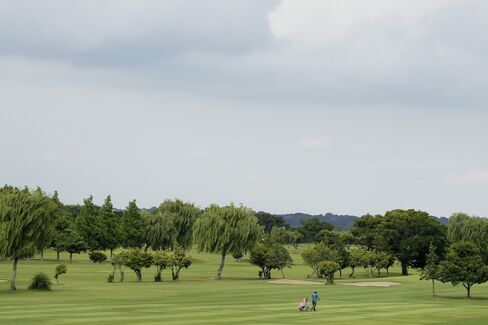
Golf is a microcosm for the problems that Prime Minister Shinzo Abe is facing in reviving Japan’s economy — low prices, unwilling consumers, a lack of female participation and an aging populace. The sport generated 1.37 trillion yen ($11.5 billion) in sales for Japan’s courses, driving ranges and equipment retailers in 2013, less than half the revenue of the peak years.
To stem the decline, courses need to appeal more to women, families and those looking to pick up a recreational hobby, said Kuramoto, whose friends call him Mr. 59 — his score during a round on Japan’s professional tour in 2003, a feat not matched by legends like Tiger Woods and Jack Nicklaus.
Nicklaus, winner of the most major tournaments, has said golf is suffering globally because the game takes too long and is too difficult and costly to play.
Nowhere has that decline been more marked than in Japan.
“Golf is becoming obsolete,” Tatsuo Sonoda, 61, said after playing a round with friends in June. “Compared with the bubble period, it has changed.”
Back in the late 1980s and early 90s, new company hires would get golf lessons as part of their training, and lines of recruits would stand by phones to book tee-off times for their bosses at courses that were often more than 100 kilometers from Tokyo.
As their own game improved, they’d have to rise at 3 a.m. to pick up senior executives before driving two hours or more to a course. They had to arrive before the clients, who would be presented with gifts of new golf balls, clubs or attire. As the game progressed, they needed to be good enough to always lose to the client by only a few strokes.
The rituals made the game synonymous with the excesses of the bubble era, putting off younger players. The number of golfers over 70 has increased by 1 million during the past decade, according to Japan’s PGA.
“Golf in Japan has an image problem,” said Hiroshi Tezuka, who owns seven courses across the country. “Golf paid for by your company is bad, golf for entertaining clients is bad, golf as a status symbol just by having the membership is bad, golfing and sacrificing the family is bad.”
As the aura vanished, so did the money.
The price of membership at the exclusive Koganei Country Club dropped from about 450 million yen in the late 1980s, to about 40 million yen, still one of the most expensive in Japan. Other clubs around the capital now offer memberships for as little as 80,000 yen, and many now allow non-members to pay a green fee to play the course.
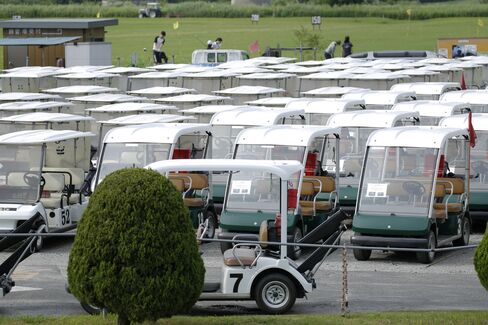
When Japan’s property bubble burst, foreign investors including buyout firm Lone Star Funds and Goldman Sachs Inc. bought hundreds of failing courses and restructured them. The two firms sold their golf-course operating companies to the public via share sales in 2005 and 2006.
In all, about 200 courses closed around the country, many of them after filing for bankruptcy. Some were just too far from the city to attract players who could now afford to play in the suburbs.
Those that remain face the challenge of getting customers to the course as car ownership among the younger generation declines.
“The car and golf are inseparable,” says Sonoda, who drove his Lexus to play at Tezuka’s Higashi Abiko Country Club in Chiba, 50 kilometers from Tokyo. He said his sons, 29 and 30, aren’t interested in either golf or owning a car. His playing partner, Hirotaro Fukuoka, a 49-year-old doctor from Setagaya, said his two teenage children prefer cycling and hiking.
Courses are trying to change that, offering a courier service to bring your clubs to the course, while you take the train, or striking alliances with rental-car companies for discounted rides.
Since last year, college kids sitting down to lunch at campus cafeterias have been courted with offers of free golf for a year once they turn 20.
If young Japanese don’t take to the sport soon, more courses could go the way of Toba Country Club in Mie prefecture and Suwa Golf Club in Nagano.
They’re being converted into solar farms.







Leave a Reply