

For some golf courses, goats serve as valuable members of maintenance staff
HINGHAM, Mass. — She wouldn’t be the first banker to seek out opportunities at local golf clubs, except Elaine Philbrick didn’t want to tee it up.
Her thought was, she could bring in something to “eat it up” — meaning the invasive plants, the unsightly weeds, the dreaded blackberry vines, the cat briar, the buckthorn. Oh, and the poison ivy. Definitely, the poison ivy would be Enemy No. 1.
“Goats love it,” said Rodney Hine, superintendent at the Boston Golf Club in this town 20 minutes south of Boston. “It’s their favorite food.”
As for Hine and his colleagues, they loathe it.
“I don’t enjoy sending crew members in to fight poison ivy. It’s not something I’d want to do,” said Glen Misiaszek, the superintendent at Cohasset GC, “so I don’t feel right in asking someone else to do it.”
Unless it’s a goat, because in adding to the list of wonders that involve nature, something so nasty to humans — poison ivy — is a delectable treat to the goat.
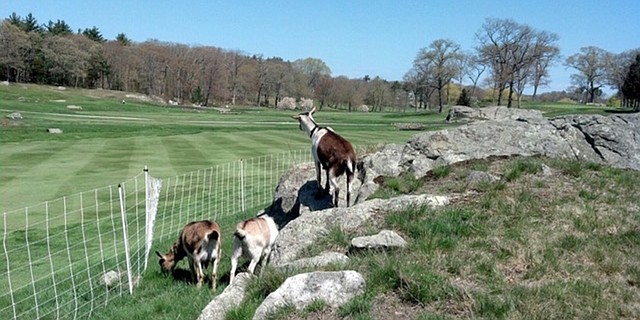
Hence Philbrick’s brilliant idea several years ago to open a business that rents out goats for land-maintenance purposes. Her company, Goatscaping, is based in Plympton, Mass., and from humble beginnings — four goats — she is up to more than 60 of the lovable animals. Thing is, they’ll be together in Plympton only for a few months starting in November; from spring to fall they’re shipped out in small herds to golf courses throughout eastern Massachusetts. The roster has been increasing every year.
Cohasset GC, Black Rock CC, BGC, Framingham CC, George Wright GC, Ridder Farm. Those are just a few of the golf courses that are using Philbrick’s goats to eradicate the unsightly, invasive plants that require so much attention. To Hine, “I’m still waiting for the downside. I can’t find any. This doesn’t have collateral.”
Hine and fellow superintendents talk of the labor-intensive effort that it would take to clear large areas of invasive plants, “and then we’d have to haul it out of there and put it somewhere else,” he said. And guess what? “Then it would grow back.”
But the goats? They clean the area, but there’s no removal. They’ve eaten it. And when they do deposit it? “It’s good fertilizer,” Misiaszek said.
When it grows back, goats eat it again and by now, they’ve likely taken the life out of the plant, leaving only a few inches of stem.
“It’s really natural,” Misiaszek said. “It’s been phenomenal.”
Plus, the goats don’t eat grass. “They’re selective mowers,” Philbrick said. “They want the leafy plants.”
Misiaszek is generally given credit by his colleagues for getting on board with Philbrick first and encouraging others to do so. Word has spread, well, like poison ivy.
“It’s a selling point (to members) and conservationists,” Misiaszek said, “because we’ve drastically reduced herbicides.”
The woman behind Goatscaping is no farm girl. In fact, “I never even had a pet growing up,” Philbrick said.
But what she developed was a love of farming, involved in the Community Supported Agriculture program. Through that program she met a golf course superintendent named Darryn Brown (Braintree Municipal), who has become sort of the expert when it comes to using goats on golf courses. In February 2012, Brown bought four five-pound goats for $10 a piece and thus began his odyssey.
Brown, who did some consulting work for Philbrick, said he learned from mistakes and today, he owns six goats that he uses to help maintain a golf course that features 13 holes next to wetlands where chemicals are a no-no. “But there are no regulations against goats,” Brown said. “We move them around in a pen and they do an amazing job.”
Whereas Brown, who has lent his expertise and consulted with Misiaszek, Hine, and other supers, built his own makeshift pen, those who rent their goats from Goatscaping also receive an electric fence that is solar-powered. It not only keeps the goats in a defined area — “We find that about a quarter of an acre at a time is optimum,” Philbrick said — but also protects against predators.
Superintendents pay approximately $10 per goat per day, or $40 a day for the herd, and by the end of the year the bill is about $7,000-$8,000. But you’d be hard-pressed to find a superintendent who’d whisper a hint of regret.
Brown has seen his goats take care of hard-to-get-to spots near wetlands, and he knows other supers are thrilled with the way the animals navigate steep slopes and outcropping of rocks where workers would be on dangerous footing. And then there’s the “right thing to do” issue.
“Nobody likes spraying the blackberry vines and deer tongue,” Misiaszek said, “but conservationists are OK with the goats.”
Architect Gil Hanse, the visionary behind Boston Golf Club, is all in when it comes to using goats. He actually put Hine in touch with the superintendent at Waverly Golf Club in Portland, Ore., where goats were deployed. Pasatiempo, the Alister MacKenzie masterpiece in Santa Cruz, Calif., is another course that has used goats.
Superintendents said that pointing to top-rated golf courses like those was a selling point to members who might have been skeptical at first, but what eventually convinces golfers is the finished product.
“It’s like scorched earth when they’re done eating,” Brown said. “It’s incredible the job they do, and it fits in well with the direction golf course maintenance is going.”











Leave a Reply