INTERVIEW: John Harrington – Driving Circularity and Environmental Sustainability Across Golf
 |
By Mike Orloff Mike Orloff is a US and Australian PGA Member with 35+ years of golf industry experience. He founded Golf Industry Central and co-founded Golf Industry Asia and Golf Industry UK/EU, connecting professionals through industry news, jobs, and events. |
In an era where sustainability is evolving from a buzzword into a commercial imperative, the golf industry stands at a critical crossroads. In this feature interview, Mike Orloff sits down with John Harrington from Golf Circularity (part of the Golf Ball Recycling framework) to discuss circular procurement management, changing board culture, reducing carbon footprints, and why embedding sustainability into club’s strategic plans is essential for long-term viability.
The Foundations of Circular Procurement
Mike Orloff: John, to kick things off, can you explain what circular procurement management actually involves for a golf facility and what drives this initiative?
John Harrington: Circular procurement management is a fascinating piece of work where we evaluate everything coming through the club’s front gate. Using our circuit register, we track purchases against a carbon data library to calculate the carbon footprint of each item.
From there, we focus on three core goals:
- Design out waste.
- Reduce operational running costs—because every dollar saved flows straight to the bottom line as profit.
- Reduce golf’s overall carbon footprint.
It is not about policing businesses; it is about education. We work alongside bodies like the PGA and Golf Australia, as well as manufacturers, retailers, course architects, and designers to share knowledge. We want to equip the next generation with better tools, so they are more knowledgeable than us, ultimately benefiting mother nature.
Consumerism, Carbon Baseline, and Auditing
Mike Orloff: We live in a heavily consumer-driven world, and golf is certainly no exception. How does circularity fit into that landscape?
John Harrington: Much of the golf industry revolves around consumerism – promoted by marketing strategies pushing the latest equipment or a ball promising an extra 10 or 50 yards.
But we also have to look at operations and major events, like the Australian Open or New Zealand Open. What is the carbon footprint of setting up and running those tournaments? Events are wonderful for health, well-being, and community engagement. However, if we measure the carbon footprint – whether for a tournament, a major brand manufacturer, or a local retail shop – we establish a baseline starting point.
From that baseline, we conduct annual evaluations through our carbon auditing process, circular fulfillment framework, and circular financial auditing. If a business measures 1,000 carbon kilos in year one and lowers that to 900 carbon kilos in year two, we know awareness is driving real, measurable progress. Through webinars, workshops, and educational tools, clubs and businesses take true ownership of running cleaner, healthier, and more cost-effective operations.
Overcoming Supply Chain Deficits and Protecting Green Wedges
Mike Orloff: In Australia and New Zealand, we face geographical realities. Because we are far from major manufacturing and shipping hubs, we start with an inherent carbon deficit just importing gear, balls, and equipment.
John Harrington: Exactly. The world’s oceans are increasingly turning into crowded shipping highways, impacting marine life and whale migration routes.
Beyond maritime impacts, urban golf courses play a crucial ecological role. We must protect the “green wedge” in our cities – preventing public courses and urban facilities from being consumed by high-density property development. As a community, we need to recognize the value of green spaces, how the game connects people, and ensure we protect these spaces rather than abuse them.
Golf has navigated countless challenges throughout its history. Today, the industry is uniquely positioned to lead on climate change without adding financial strain to the bottom line.
Habit Changes, Global Waste, and Regional Trade Dynamics
Mike Orloff: It often comes down to simple daily habits and changing consumer mindsets.
John Harrington: It really is about simple habit shifts – like sitting down with mates in the clubhouse for a coffee in a proper mug rather than rushing onto the first tee with a single-use takeaway cup that ends up in the bin.
Across the global landscape, major governing bodies are making strides; the R&A is supporting agronomy and environmental initiatives, while the European Golf Association recently convened key stakeholders at the Solheim Cup.
However, big challenges remain. During a trip to Europe, I noticed massive volumes of golf balls still heading to landfills across Scotland, Ireland, and England. It raises critical questions: Is one country becoming a dumping ground for another?
Is Australia becoming a dumping ground for second hand gear? For instance, Drummond Golf was recently acquired by a Japanese business that proposed bringing second hand equipment into our market. We need to evaluate whether flooding the market with old stock serves our long-term circular goals or merely shifts waste problems across borders.
Embedding Sustainability into Strategic Plans
Mike Orloff: I recently facilitated the R&A Game Changer workshop in Brisbane. A key takeaway was that sustainability cannot just be an isolated subcommittee; it must be embedded into a club’s strategic plan. If it is not in the strategic plan, busy General Managers will naturally prioritise other daily urgent tasks.
John Harrington: I completely agree. Environmental sustainability and circular environmental management planning should be a top pillar in every facility’s strategic plan.
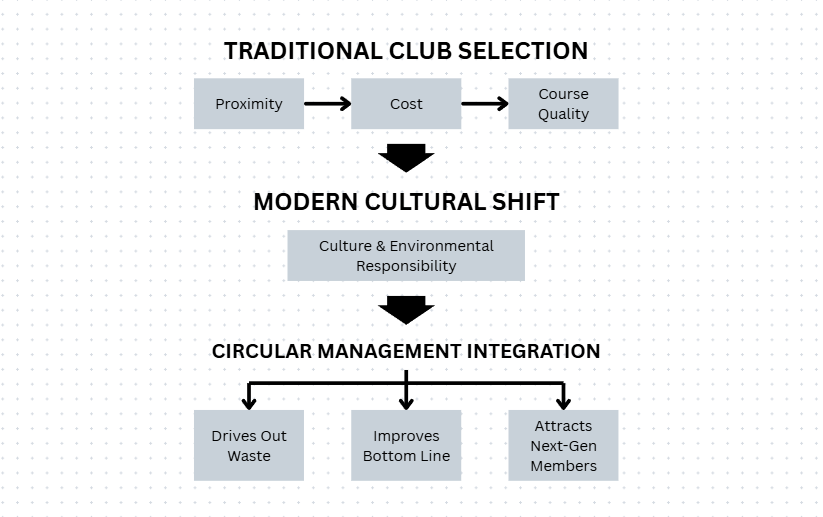
Historically, golfers picked a club based on proximity, cost, and course quality. Today, prospective members – especially younger generations – look at course culture first. Culture is built on community engagement, welcoming new members, and taking care of the environment.
When you establish a Circular Environmental Management Plan, it directly complements financial management. It drives out waste, channels savings straight to the bottom line, reduces your carbon footprint, improves culture, and attracts future members.
As peak bodies and associations continue discussing sustainability, it will organically move onto board and management agendas. We are also working toward an industry charter with terms of business to help guide clubs smoothly through this learning process.
Regional Champions and Operational Savings
Mike Orloff: Are there specific facilities across Australia and New Zealand that stand out as circular economy leaders?
John Harrington: We see incredible work across our network:
- New Zealand: Public and Private courses like Chamberlain Park, Royal Auckland and Grange, Redwood Park, Pupuke, Clarks Beach in Auckland and Waimairi Beach in Christchurch.
- South Australia: The Grange, Kooyonga, Royal Adelaide, and West Beach Parks (The Pat, who have actively embraced Indigenous culture into their induction process). South Australia’s broader culture around composting and waste separation sets a fantastic standard.
- New South Wales: Moore Park, Roseville, Eastern Monash Oatlands & Monash Country Club in Sydney, where the team in the pro shop actively drives circularity initiatives.
- Queensland: Ashgrove Golf Club and Topgolf on the Gold Coast, who focus on improving their circular model by 5–10% every year.
- Tasmania: Kingston Beach, Lanuceston, Devonport and Ratho Farm (the oldest golf course in Australia).
- Victoria: Monash Council and Melbourne Park Driving Range have actively embraced Circularity into everyday business, The Waverley Transfer Station, Oakleigh and Glen Waverley Golf Courses were among the first to embrace Golf Ball Recycling Reuse Repurpose Recycle programs.
- Western Australia: Royal Fremantle, Royal Perth, Busselton, Pinjarra, and Lake Karrinyup. Higher utility and water costs in WA and SA have made those operators particularly savvy with their environmental planning.
There are so many more, I apologise if I don’t recall everyone.
In states like New South Wales and Victoria, state government funding initiatives – such as FOGO (Food Organics and Garden Organics) and Bin Trim programs – offer dollar-for-dollar grants that offset implementation costs for clubs.
Innovations, Community Impact, and Next Steps
Mike Orloff: Turf management and irrigation technology have also advanced dramatically. Superintendents are managing moisture sensors, targeted watering, and reduced chemical usage rather than blanket spraying.
John Harrington: Superintendents do an amazing job under challenging conditions. Through our School on the Green initiative, we encourage young people to explore sports turf management and agronomy careers, highlighting environmental stewardship, native flora and fauna protection, and resource conservation.
Look at what facilities can achieve: a golf club in Queenstown recently went completely off-grid with solar power and secured bank financing at below commercial rates through green funding programs. Furthermore, off-grid golf courses with battery storage and commercial kitchens are being recognized by local governments as emergency disaster recovery centers during extreme weather events like floods or bushfires.
A strong circular environmental management policy yields benefits far beyond the fairways—it strengthens the whole surrounding community.
Looking Forward
Mike Orloff: We only have one “golf ball” floating around in space that we all live on, so we have to look after it!
John Harrington: That is spot on. We do not need to reinvent the wheel overnight; a steady-as-she-goes approach focusing on incremental 1% improvements make a huge collective impact across 2,000+ facilities in Australia/ New Zealand alone. When procurement officers wear an environmental hat, when clubs design out waste, and when sustainability becomes a board-level priority, the entire industry prospers.
To learn more about implementing circular procurement frameworks, golf ball and equipment recycling, or environmental course management audits, visit Golf Circularity Group.