The Future of Turf Care lies with Electrification and Automation
As you all know, green spaces have the power to play a significant role in combating climate change and decreasing the earth’s carbon footprint. However, to make a significant difference we need to look to green space management and combat issues within the industry.
Reflecting on the fact that maintenance of green spaces has its carbon footprint, and if we continue to increase green spaces in our towns and cities as a climate mitigation tool, then we need to explore solutions that can be scaled without further emissions.
Industry experts believe that automation and robotics have significant potential to combat the issues adding to climate change, but also have a positive impact on other industry challenges; cost pressures, labour shortages, health and safety, and turf quality/environmental impact.
The attached white paper on ‘The role of robotics and automation in green space management‘, commissioned by Husqvarna Australia, which contains independent perspectives from experts across academia, and turf/green space management, discusses the benefits of adopting robotics and how automation can address workforce issues and improve the environmental footprint of green space management.
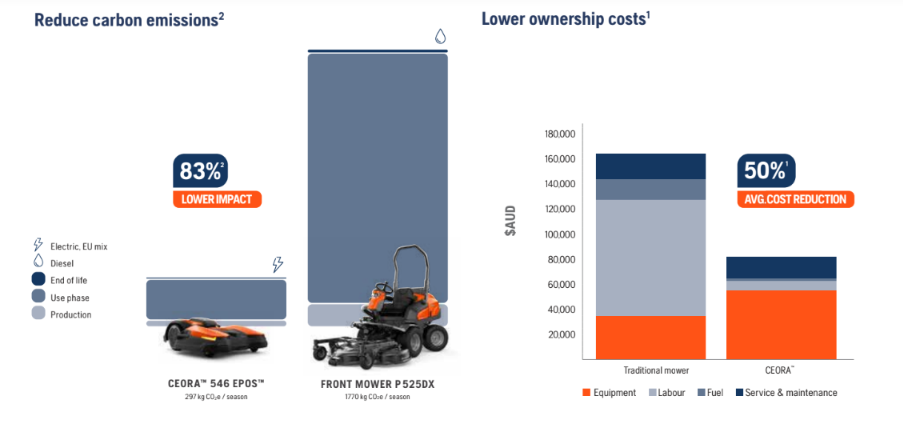
For example, a robotic mower can cut emissions by 83%, but also due to the autonomous nature of the technology, can run independently once set up and free up time for employees to focus on more value adding work.
The paper was written in collaboration with three industry experts.
John Kalocsai, the Director and Co-Founder of Greenworx and Joe Rogers, Commercial Manager at Lawn Solutions Australia (LSA) are available for comment or interviews.
Key Takeouts:
-
Key Takeouts:
- Labour shortages require new solutions:
Commercial autonomous mowers provide a labour resource solution to support labour shortages, automating the more mundane landscaping tasks, freeing up labour capital to perform the more complex, skilled tasks. - Lowering operating costs:
Transitioning from conventional commercial mowers to robotic mowers has been shown to significantly reduce turf maintenance operating costs by up to 50 percent. - Improved turf quality:
Autonomous mowers cut frequently, promoting grass to grow thicker and more evenly, and deposit clippings into the soil providing natural fertilisation, enhancing the overall health of the grass.
- Gentler on the environment:
Commercial robotic mowers are battery-powered, low in noise and no direct emissions during use; with the potential to significantly reduce carbon emissions, highlighting the significant impact embracing this technology can have on mitigating environmental impact.
- Labour shortages require new solutions:
Click here to read the report here – https://www.flipsnack.com/