Swampy eyes retirement
‘Swampy’ eyes retirement
By David Newbery
Graham Marsh says he can see the finish line.
The man affectionately known as Swampy told Golf Industry Central he would quit the US PGA Champions Tour within two years.
He has already started scaling back his playing schedule.
“I am cutting back quite considerably now and will play for another year or two and that’s as far as I’ll be going,” said Marsh, who has played professionally for four decades.
“I’m down to 15 tournaments a year and next year I’ll only play 12.”
The 65-year-old has had a stellar career winning 68 professional tournaments worldwide including one win on the US PGA Tour where he rarely played, 10 on the European Tour, 20 in Japan, 14 on the PGA Tour of Australasia and six on the Champions Tour including two majors – the US Senior Open (1997) and The Tradition (1999).
His best result in major championships was a tied ninth in the US Masters (1976), fourth in the Open Championship (’83), tied seventh in the US PGA (’78) and a tied 16th in the US Open (’79).
There is little doubt he could have played successfully on the US Tour after winning the 1977 Heritage Classic and was named rookie of the year.
But he opted for the Japan Tour and a Perth (West Australia) base.
He said he could have contended in more majors and been a better player had he played in the US, but he was determined to raise his family in Australia.
That virtually ruled him out of three of the four majors each year when winning a major was one of his goals.
That was hard enough, but he also played during an era when superstars littered the fairways.
“I saw some of the greatest players and I would consider the group to be the greatest,” he said.
“I think of Jack Nicklaus, Arnold Palmer, Gary Player, Lee Trevino, Tom Watson – those guys have won seven, eight and nine majors and in Jack’s case 18.
“In this era we have one man (Tiger Woods) with 14, but the most number of majors the others have won has been three.
“I feel very fortunate in my competitive career that I played with players that will stand the test of time.”
In 1984, Marsh was awarded the MBE by Queen Elizabeth II in recognition of his services to golf.
He was chairman of the PGA Tour of Australasia for six years and was instrumental in the introduction of a number of professional tournaments to the tour’s schedule.
Sadly, many of those tournaments have been erased from the calendar.
Marsh may be 65 and considering retirement from tournament play, but judging on the basis of his golf course design enterprise, there’s no evidence he’s slowing down.
Established in the mid-1980s, Graham Marsh Golf Design has become a global company.
The company was established during the development of Palm Meadows on the Gold Coast when Japanese developer Daikyo commissioned him to design the golf course.
Since then Marsh has been in demand and has won high praise for his work around the world.
His Australian portfolio includes The Vines (WA), Paradise Palms (Cairns, Qld), Robina Woods (Gold Coast), Northlakes (Brisbane), Terrey Hills (Sydney), Secret Harbour (WA), Horizons (NSW), Cottesloe (WA), Anvil Creek (NSW), Emerald Lakes (Golf Coast), Gosnells (Perth, WA), Eynesbury and Growling Frog (both Melbourne).
Marsh-designed golf courses can also be found in the US, New Zealand, Japan, Indonesia, Morocco, Malaysia, China, Germany, Cyprus and the Middle East.
He is an unabashed fan of course architects Alistair MacKenzie and Harry Colt.
“To me Alistair MacKenzie set a very high standard with what he did, but Harry Colt was a brilliant architect,” he said.
Of the modern day architects, Marsh admires the work done by Ben Crenshaw and Donald Ross.
Marsh’s philosophy is to design and build world-class golf courses that all levels of golfers can enjoy.
“The thing I will say about our golf courses is they are built around strategic design – not penal design,” he said.
“That’s the underlying factor that I apply to all our designs.
“They must be strategic in nature, which gives the greatest number of people the opportunity of being able to play on the golf course.”
Marsh said he was yet to design the perfect golf course – if there is such a thing.
“Have we built the perfect golf course? Absolutely not. Are we likely to? Probably not.
“But we continually try to push the envelope of design to create challenging and interesting designs that many people can enjoy.
“I think our track record over a period of time has shown that almost without fail every one of our golf courses is heavily used.
“People play them and the greatest compliment a designer can have is that people play the course and enjoy them.
“More importantly, the golf course must be sustainable in as much as it is not a high cost to maintain.
“It’s about the membership being able to afford to play golf with the club not going bust.”
One of a number of developments Marsh is currently working on is a championship golf course in his home-town of Kalgoorlie in West Australia’s south-east.
Work on the $50m Kalgoorlie-Boulder Golf & Spa Resort is expected to be competed in April 2010.
It is expected to rank in the top-10 desert golf courses in the world.
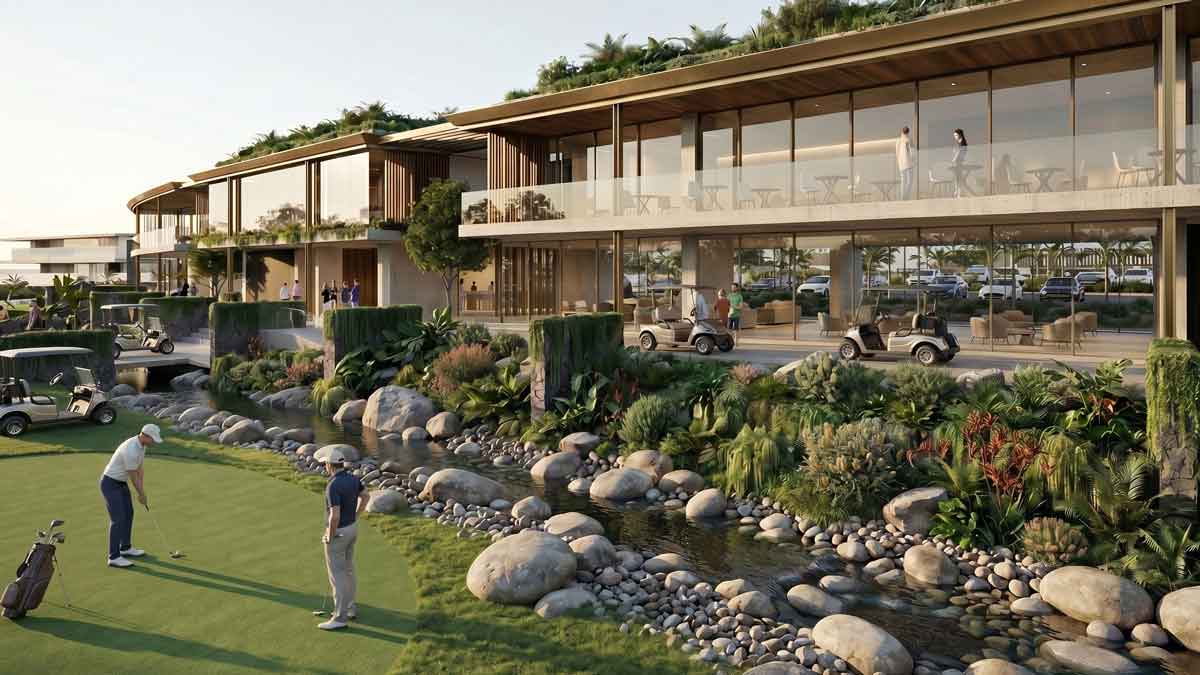
Plans include a five-star resort with 120 rooms and 16 private villas, each with its own swimming pool.
There’s even an air-conditioned indoor tennis facility that can be adapted as a convention and function centre.
While Marsh is passionate about course design, he is also an outspoken critic of advances in technology.
He says technology has forced developers to purchase more land to keep pace with golfers hitting the ball further.
“The equipment manufacturers brought on their changes trying to gain an edge in technology and in sales and they were allowed to do that under the rules that were provided.
“Now the ball is travelling so far, golfers can hit the ball straighter because of grooves they were allowed to use.
“There is no doubt golf courses are longer and almost every designer is designing golf courses longer than in the 1960s and 1970s,” he said.
“Back then 7000 yards (6400m) was considered a massively long golf course. Now it’s not uncommon to have a 7000-metre golf course.
“That’s the problem the game is faced with.
“There are some courses that are 6200m, but they usually turn out to be very narrow with very small well-guarded greens.
“An amateur can enjoy playing those types of golf courses, but his score actually goes up because of deeper bunkers, smaller targets and higher penalties when they miss the green.
“At all levels the skill to get the ball up-and-down around the greens doesn’t make the game more fun for the average guy.
“He may go with a shorter club, but he takes more strokes to get the ball in the hole.
“There is a strange way the game has evolved out of 6800m being a very fair golf course and it’s just being a complete change of skill levels.
“The average guy is not that good.
“If you want to make a golf course 6300m and want to make it a big challenge then the challenge has to be what you do around the greens.”
GRAHAM MARSH PROFILE
Born: 14th January 1944 (Kalgoorlie, WA)
Height: 1.80m (5’11”)
College: University of WA and Claremont Teachers College
Turned pro: 1969
Pro wins: 68
US PGA Tours wins: One
European Tour wins: 10
Other European wins: 4
Australasian wins: 14
Japan Tour wins: 20
Other wins in Japan: 5
Asian wins: 5
Champions Tour wins: 6